Winnie-the-Pooh Day!
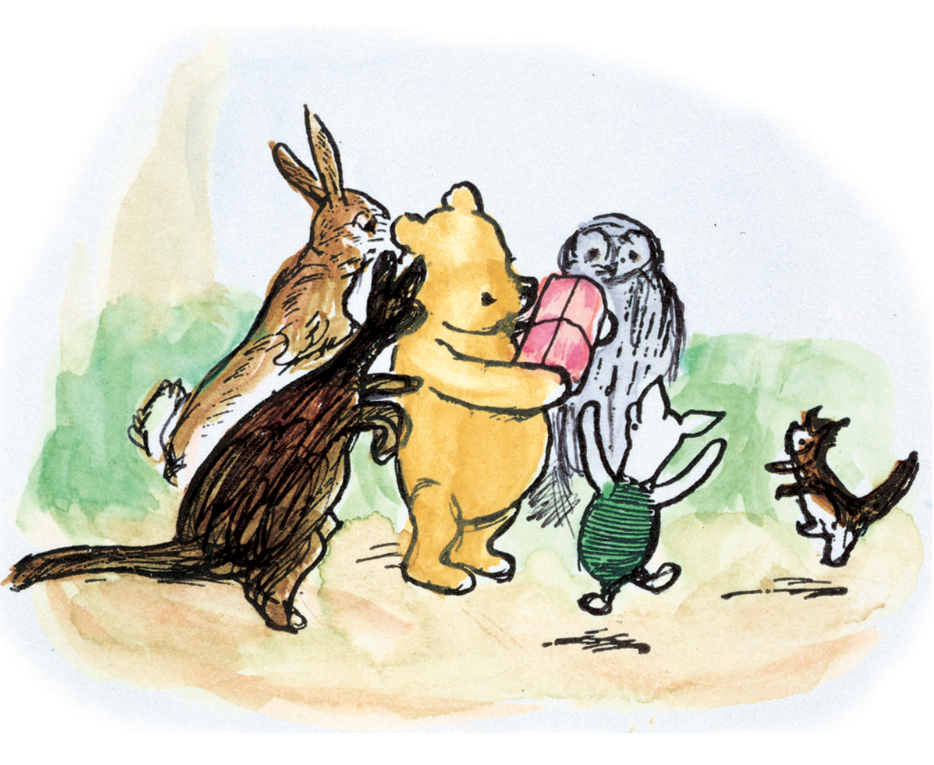
On January 18, 1882, A. A. Milne, author of your favorite teddy bear and his woodland friends, was born in London, England. Since 1986, libraries and book lovers have celebrated his timeless creation on his birthday as National Winnie-the-Pooh Day.
Alan Alexander Milne had an early life touched by notable literary connections. His father was from the then British colony of Jamaica, and ran an independent school that Milne attended. H. G. Wells was one of his teachers there. Milne graduated from Trinity College, Cambridge in 1903 with a mathematics degree. He played on a cricket team with his idol J. M. Barrie, friend-then-foe P. G. Wodehouse, and Sir Arthur Conan Doyle. Although a pacifist, he voluntarily enlisted in WWI, where after contracting trench fever he was recruited into military intelligence to write propaganda for M17, and later served in WWII.
His only child Christopher Robin Milne was born in 1920. A year later, on his first birthday, he received an Alpha Farnell teddy bear originally named Edward purchased from Harrods, and later that year for Christmas he received a gray stuffed donkey named Eeyore. The first decade of his childhood he spent being raised primarily by his nanny, who he would later dedicate his memoir to. He eventually changed the bear’s name from Edward to Winnie, after being inspired by a Canadian black bear named Winnie he saw at the London Zoo.
In 1925, Milne purchased a country home called Cotchford Farm in East Sussex, as a weekend, holiday, and summer getaway from their London flat. It was located on the northern edge of the Five Hundred Acre Wood in Ashdown Forest. Pooh illustrator E. H. Shepard actually used the real landscapes from the forest in his illustrations. It was also in 1925 that Winnie-the-Pooh first appeared by name, on Christmas Eve in a children’s story commissioned by London’s Evening News.
Many people are surprised to learn that Milne was primarily a successful published playwright and screenplay writer, with several of his works staged. He also published poetry, novels, a murder mystery, and works of nonfiction. As a writer, he was adamant on allowing himself the freedom to explore whichever genre he felt drawn to, readily finding success and a new audience with each pivot. The overwhelming popularity of Pooh was often frustrating for him, as he only wanted to write from a place of organic inspiration and his son had since grown. Likewise, he was disturbed with the fame his son was exposed to at a young age and wanted to protect him from that. So only four Pooh books were written.
The real Christopher Robin went on to become a bookseller, opening his own bookstore called Harbour Bookshop in 1951 with his wife, who was his first cousin on his mother’s side. He found his legacy to burdensome and embarrassing, wanting little to do with the series as an adult, and disliking Disney’s commercialization. Eventually becoming estranged from his both of his parents, and not even visiting his mother on her deathbed.
In 1952, Milne suffered a stroke and underwent brain surgery, which sadly left him disabled and bound to a wheelchair. He died in 1956 at the age of 74. He bequeathed the original Winnie-the-Pooh manuscripts to Trinity College Library, Cambridge, where they are still housed today. Many of his other works and personal letters can be found at the Harry Ransom Center at the University of Texas at Austin.
Christopher Robin Milne’s real stuffed animals (Pooh, Eeyore, Piglet, Kanga, and Tigger) have been housed at The New York Public Library, making their public display on September 11, 1987. He originally gave them to the book’s editor, who in turn donated them. You can now visit them permanently showcased in the Polonksy Exhibition of The New York Public Library's Treasures. Notably missing is Roo, who was lost in an apple orchard in the 1930s.
Disney licensed the rights in 1961, with Winnie-the-Pooh becoming Disney’s most successful character property, generating billions of dollars annually, only surpassed by Mickey Mouse himself. The original stories and illustrations entered public domain in the United States on January 1, 2022, however, the UK’s and Disney’s versions are still under copyright protection.
You can celebrate by reading the original books, watching the Disney movies, tasting some local artisanal honeys at the farmer’s market, or reading my personal favorite, The Tao of Pooh by Benjamin Hoff. From our Hundred Acre Wood to yours!