Happy Birthday Thomas Paine!
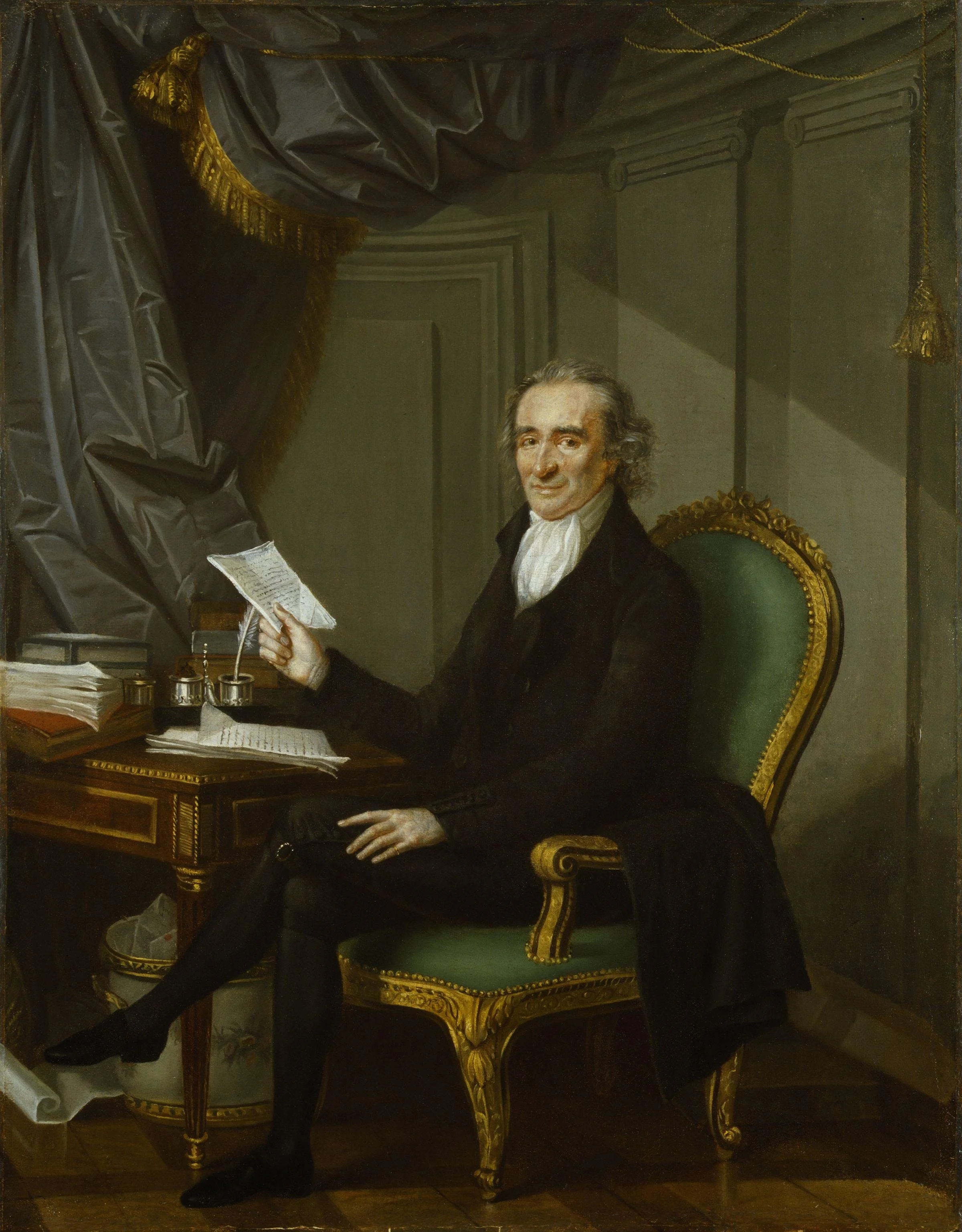
If you’ve been on our Greenwich Village Literary Pub Crawl Tour, you’ll know all about English-born Founding Father and French Revolutionary Thomas Paine, and his alleged… err… shall we say, life after death. He is most famous for his pamphlet Common Sense, which influenced the spark of the American Revolution. At the time it was published, it was the second most owned book next to the Bible. You could find a copy in every home. Basically, it was the Harry Potter of the late 1700s. John Adams wrote, “Without the pen of the author of Common Sense, the sword of Washington would have been raised in vain”. This quote is much more profound when you consider that Adams actually hated Paine, and by the end of his life would call Paine’s work “a poor, ignorant, Malicious, short-sighted, Crapulous Mass”. Yes, “crapulous”. You are welcome.
He was born on January 29, 1736 in the “Old Style” calendar system, or February 9, 1737 in the “New Style” calendar system. The calendar system is an entirely separate story itself. Maybe we’ll talk about that next week. His birth name was actually spelled “Pain”, and he was so tired of people calling him “Thomas Ow!” that he added the ‘e’. Kidding, he obviously won the vowel in a game of Wheel of Fortune. Pain(e) ended up in America with the help of Benjamin Franklin in 1774. Seems suspicious, almost as if Ben literally imported him to rabble-rouse. His life in England involved losing his wife and unborn baby to childbirth, and following his father’s footsteps as a corset maker.
He had a lot of CRAZY ideas such as human rights; that slavery should be illegal, and women are people. Radical ideas for the 2000s. Sorry, I mean the 1700s. He wrote about them in his essays, “An Occasional Letter On The Female Sex” and “African Slavery in America”. I truly believe that he supported women, because after he came to America he never made another corset again. The OG bra-burner. He also rejected institutionalized religion and Christianity, praising Deism instead. In his The Rights of Man, published in 1792, and Agrarian Justice, published in 1797, he established the financial calculations for a social security plan which would provide free education, pensions, health care, and insurance for the disabled. He also argued for public works funded by the state that offered a guarantee of full employment. He considered these programs to be human rights, instead of charity. Paine’s ideas on how to organize society were deeply inspired by the Iroquois League of Nations: their model of democratic decision-making and their relationship with nature. He also put his money where his mouth was. Despite being poor, he donated his earnings from Common Sense to buy supplies for the Continental Army and served himself.
Obviously, he had many friends and no enemies, and was never imprisoned for his writings. All of the rich landowners loved the idea of giving up their gold to support others and letting their slaves go free. Women began voting and had complete and equal rights to men, and were paid equal wages right into their own bank accounts. Sorry, I think I had a stroke. Turns out the British were not up for their own “R“evolution, so they charged him with seditious libel after his Rights of Man became a bestseller in 1792. He fled to France, but was arrested in Paris for treason in December 1793 due to his opposition of the death penalty and the guillotine. Paine was very into revolutions and very against headlessness. James Monroe helped Paine get out of jail, and after staying in Paris for some time, he returned to the United States. He spent his remaining years primarily in New York, splitting his time between New Rochelle and Greenwich Village, where he eventually died. Only six people attended his funeral. After helping win both the American and French Revolutions, he was politically and socially ostracized for his “unrealistic” views of society, government, and religion.
After his death, Paine’s legacy was restored over time, going on to influence many political and social movements throughout the 1800s and 1900s. Many great Americans, including Thomas Edison, Walt Whitman, and Abraham Lincoln, credit Paine’s work as their inspiration. Roosevelt (F.D.R.) read Paine’s The American Crisis over the radio in one of his fireside chats three months after Pearl Harbor. And even Ronald Reagan was moved, quoting Paine’s Common Sense after accepting the Republican Party’s nomination for presidential candidate in 1980, saying, “We have it in our power to begin the world over again”. What a stark and powerful phrase, which sounds hopeful in some mouths and dreadful in others.
It seems more important than ever to remember that these are the times that try men’s souls. We have done this before and we will overcome it again, as long as our bookshelves and nightstands remain full of literature.
I leave you with a quote that seems eternally relevant.
“To argue with a man who has renounced the use and authority of reason, and whose philosophy consists in holding humanity in contempt, is like administering medicine to the dead, or endeavoring to convert an atheist by scripture.”
— Thomas Paine, The American Crisis
Cheers to Thomas Paine! And if you are not familiar with the story about his death, please come on our next Greenwich Village Literary Pub Crawl.