A Darkling Descent into Summerween: Poe’s Raven and Gothic Reveries
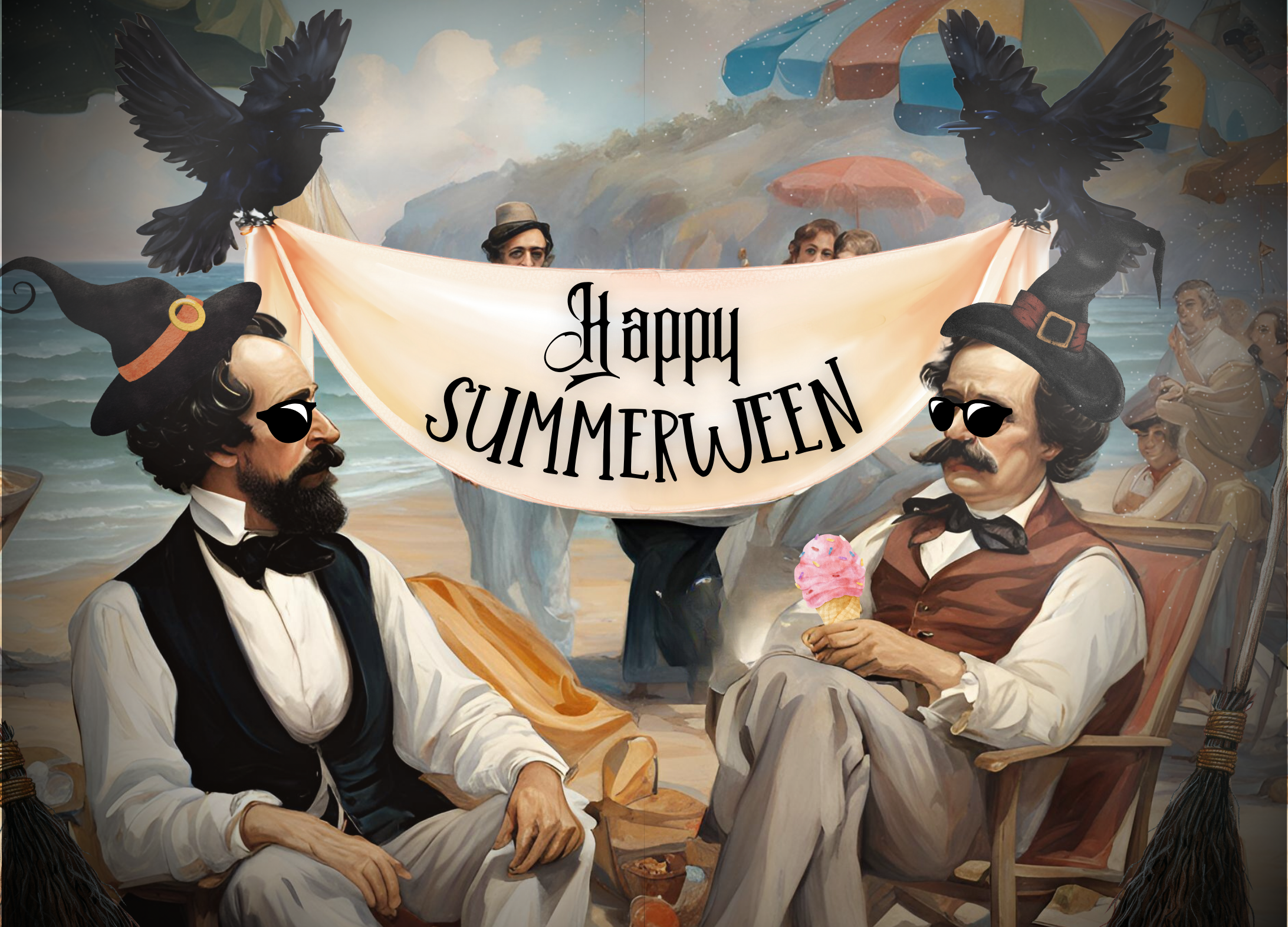
Summerween is fully upon us! What is Summerween, you ask? At its core, it is a lifestyle choice. According to The New York Times, the term originated from the animated Disney Channel series Gravity Falls, where the residents of a fictional town in Oregon celebrate Halloween not once, but twice a year–on October 31st and June 22. They carve “jack-o-melons” instead of pumpkins and blend traditional summer activities with ghoulish flair. In the real world, Summerween is simply permission to indulge in our early longings for fall. When the great outdoors transforms into a sticky jungle, there’s something deeply comforting about the thought of a light crisp breeze, perhaps a pumpkin spice candle or a few festive gourds to bring forth a little coziness and serenity. Let’s not ignore the commercial aspect–stores have unabashedly donned their holiday aisles with Halloween goods as early as June this year, nestling an abundance of goblins and broomsticks and ghosts (oh my!) next to the back-to-school backpacks, pool floaties, and fireworks. What Summerween means for us is an opportunity to revel in Gothic lore, to embrace stories that evoke a tantalizing tingle along your spine, to start a faux-fire (it is still August after all), and pull out delightfully dusty copies of The Raven and The Tell-Tale Heart.
One of my favorite crossover moments in literary (and seasonal) history involves the father of Christmas (as we know it), Charles Dickens, and the father of Gothic horror (unless you ask Horace Walpole fans), Edgar Allan Poe, when they broke bread together in 1842. Despite the brevity of their interaction, Poe and Dickens had a fascinating connection, ignited by the love of criminal conundrums and a raven. An avid cryptographer, Poe was tickled pink when, in 1841, Dickens released the first few chapters of a murder mystery, Barnaby Rudge. Before Dickens even finished writing the final chapters, Poe eagerly published his review of the partial work, predicting the identity of the murderer, to which Dickens remarked, astounded: "He must be possessed of the devil.”
During his first tour of the United States, Dickens was approached by Poe, who was eager to meet him in person. Their encounter is believed to have taken place in Philadelphia on either March 6th or 7th (or both) at either Dickens’ hotel or the offices of Graham’s Lady’s and Gentleman’s Magazine, where Poe was a contributing editor. Some reports suggest that the meeting was cold and awkward, that Poe took the opportunity to recite an Emerson poem A Humble-Bee aloud to Dickens (as one does), and that there was a stark contrast between Dickens’ gold and velvet finery and Poe’s somber, tattered attire. While accounts of the atmosphere vary, we do know that Dickens had a profound effect on Poe. Dickens later penned that Poe expressed how he had awoken “a new era” in his mind. Poe also implored him to secure him a publisher in London–a request Dickens was unable to fulfill—and although Poe’s admiration was slightly dimmed by disappointment, he continued to model several of his works after Dickens’, the most famous of which being The Raven. When many envision Poe, the image of the raven often comes to mind–an iconography deeply tied to Dickens as well. It was the character of Grip, a talking raven in Barnaby Rudge based on Dickens’ own beloved pet raven (also named Grip) who utterly enchanted Poe, carving out his lasting legacy in Gothic lore. Some might even argue that The Raven is, echoing other Dickensian tales, a Christmas ghost story, set on a cold December eve around a fire–yet another exciting seasonal crossover. Summerweenmas anyone?
With that, we wish you a very happy Summerween, however you choose to celebrate it and encourage you to get into the spirit with some Gothic reading. And, of course, if you do feel compelled to carve a raven into a watermelon, we’d really love to see it.
Suggested Summerween Reading:
Barnaby Rudge by Charles Dickens, followed by The Raven by Edgar Allan Poe
The Chimes by Charles Dickens, followed by The Bells by Edgar Allan Poe
A Confession Found in a Prison in the Time of Charles the Second by Charles Dickens, followed by The Tell-Tale Heart and The Black Cat by Edgar Allan Poe
What do you think Dickens awoke in Poe?
P.S. If you prefer video / audio content, you can listen to a modified version of this tale, plus other fascinating tales, presented during one of our virtual tours on Youtube!