The Cost of Nostalgia
A Night Out with F. Scott Fitzgerald in 2026
“The test of a first-rate intelligence is the ability to hold two opposed ideas in the mind at the same time, and still retain the ability to function.” — F. Scott Fitzgerald
Imagine it’s a warm evening in 1925. The streets of Greenwich Village hum with jazz spilling out of basement clubs. Cigarette smoke curls beneath dim lights as artists, writers, actors, intellectuals, and bohemians crowd into cafés until dawn. Okay, fine… perhaps we could do without the cigarette smoke. Somewhere near Washington Square, F. Scott Fitzgerald finishes a manuscript page, pockets a few dollars, and suggests, “Let’s go out, old sport”.
The question is: how much would that evening cost in 1925? And could you even afford it in 2026?
One of New York’s most creative neighborhoods transformed from an affordable haven for struggling artists, into one of the most expensive places in America. Using original restaurant menus preserved by the New York Public Library, government inflation data, and contemporary accounts of Jazz Age New York, we reconstruct what an evening in Fitzgerald’s Greenwich Village might have looked like, and how dramatically the economics of the neighborhood have changed.
Dinner at the Hotel Brevoort
In the 1920s, Greenwich Village was filled with neighborhood Italian restaurants, French cafés, oyster houses, and modest taverns. Although Fitzgerald wandered throughout Manhattan, one establishment appears repeatedly in biographies and memoirs: the Hotel Brevoort. Standing at Fifth Avenue and East 8th Street, just north of Washington Square, the Brevoort served as a gathering place for editors, publishers, writers, and artists, even famously serving royalty.
Menus preserved in the New York Public Library’s Buttolph Collection show that in the mid-1920s a diner could expect prices similar to these:
Blue Point Oysters: $0.60
Sirloin Steak: $1.75
Coffee: $0.10
Ice Cream: $0.20
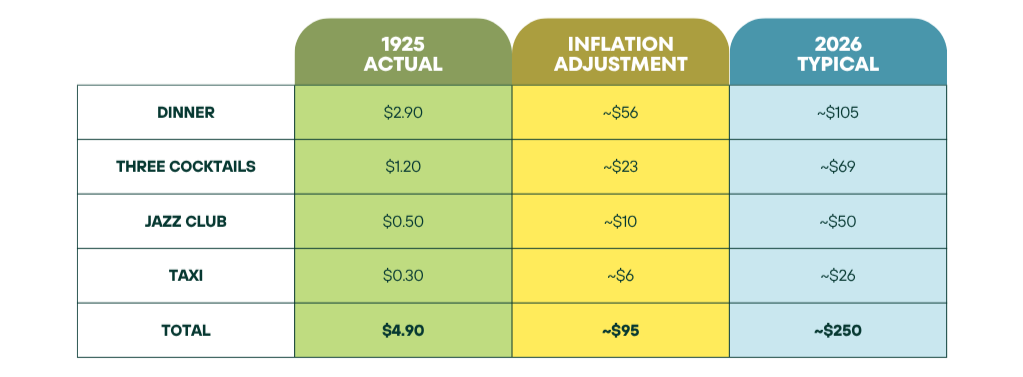
A complete dinner cost approximately $2.65-$2.90. According to the U.S. Bureau of Labor Statistics Consumer Price Index (for May 2026), that meal would equal roughly $51-$56 today if adjusted only for inflation. Yet 50 bucks does not get you a comparable dinner in Greenwich Village today. A dozen oysters often begins around $24. A steak entrée commonly exceeds $55. Dessert adds another $14, and coffee another $5 or $6. The total approaches $100-$110, nearly twice what inflation alone would predict. Rent, labor costs, tourism, and the neighborhood’s prestige all contribute to prices that have risen much faster than inflation alone.
Cocktails During Prohibition
Ironically, Fitzgerald’s favorite pastime was technically illegal. The Eighteenth Amendment and the Volstead Act had outlawed the manufacture and sale of alcohol nationwide, but New York largely ignored Prohibition. Speakeasies flourished throughout Greenwich Village, often hidden behind barbershops, soda fountains, unmarked doors requiring a password, or masquerading as tea rooms.
A typical cocktail cost between 35 and 50 cents, depending on the quality of the liquor. Suppose Fitzgerald ordered (a modest) three gin cocktails during the evening…
1925 total: ~ $1.20
Inflation-adjusted: ~ $23
Yet today, three craft cocktails in Greenwich Village would likely cost between $60-$75 before tax and gratuity.
An Evening of Jazz
The soundtrack of Fitzgerald’s New York was jazz. Neighborhood clubs charged surprisingly modest admission. Many clubs had no cover at all; others charged 25-50 cents, particularly if a popular musician was performing.
1925 admission: $0.50
Inflation-adjusted: ~ $10
Today, an evening of live jazz in the Village often includes a cover charge of $25-$40 plus a drink minimum, bringing the average cost closer to $50.
A Taxi Home
By midnight, Fitzgerald might hail one of New York’s yellow taxicabs, as he was famous for his chaotic drunken brawls with cab drivers over fares, incorporated into his novels like The Beautiful and Damned.
1920s standard flag drop: ~ $0.30
Inflation-adjusted: ~ $6
Instead, the same journey through Lower Manhattan commonly costs $25 or more, thanks to traffic, labor costs, insurance, and demand-based pricing. Also, you’re more likely to take an Uber or a Lyft over a yellow cab.
The Total Cost of an Evening
A complete evening with Fitzgerald in 1925 cost less than $5. Adjusted strictly for inflation, we would expect that experience to cost just under $100 today. Instead, it now costs roughly $250. The difference is not merely inflation; it is the transformation of Greenwich Village itself.
The Neighborhood That Changed
During Fitzgerald’s lifetime, Greenwich Village was an affordable refuge for artists, immigrants, musicians, and political radicals. Apartments were inexpensive enough that struggling painters could share studios while aspiring novelists wrote in cafés. Today’s Village remains culturally vibrant, but soaring property values have fundamentally altered its character. Commercial rents rank among the highest in the country, restaurants operate under dramatically different labor and operating costs, and tourism has transformed many once-local establishments into global destinations. Ironically, the neighborhood now resembles the glamorous New York that Fitzgerald imagined for Jay Gatsby more than the bohemian Village Fitzgerald actually knew. Many artists who once would have called it home now live in outer boroughs or entirely different cities.
Fitzgerald himself often struggled with money despite his fame, famously earning and spending at astonishing speed. When The Great Gatsby was published in 1925, it sold modestly during his lifetime. Much of Fitzgerald’s income came from magazine stories rather than novels. He and his wife, Zelda, became infamous for extravagant spending, luxurious hotels, champagne-fueled parties, and spontaneous trips to Europe. Financial anxiety remained a constant throughout his life despite his literary success. He might not be surprised that people still gather in Greenwich Village to talk about books over cocktails, but he would almost certainly be stunned by the check. More than a century after The Great Gatsby appeared in bookstores, the greatest change isn’t the menu; it’s the price of belonging to the city that inspired it. Which begs the question, can we still afford it and at what cost?