Burroughs, Cut-up Technique, and the Occult
William S. Burroughs was a foundational figure of the Beat Generation along with his friends Allen Ginsberg and Jack Kerouac. He is best known for his postmodern novels Junkie and Naked Lunch. He is a hugely inspirational figure to musicians, artists, filmmakers, and authors, coining terms like “heavy metal” and appearing on the album cover of The Beatles’ Sgt. Pepper’s Lonely Hearts Club Band. A heroin addict and lover of all drugs, he was a pioneer of ayahuasca tourism, traveling through Ecuador and Columbia experimenting with plant-based DMT to expand his psychic powers. He was also… unhinged… seems like a polite way to put it. When he was 26, enraged with jealousy over his boyfriend’s affairs with women, he cut the top of his pinky finger off with the intention to gift it to him to prove his love, but instead gave it to his psychiatrist who had him committed. Later in 1951 when he was 37 living in Mexico with his wife and kids, he drunkenly attempted to play “William Tell” and shot his wife dead, accidentally when missing the glass on her head. If Burroughs seems like a kooky genius with a Harvard degree, it is because he comes from a long line of them with his grandfather inventing the first automated adding machine in the 1880s (think prehistoric calculator). The Burroughs Adding Machine Company was worth $430 million in 1920. Although the family sold the rights to the invention, they were fortunate enough to have sold their $200,000 in stocks before the market crash. Plus, his uncle was the publicist of the Rockefeller family. Nepo babies, eat your hearts out!
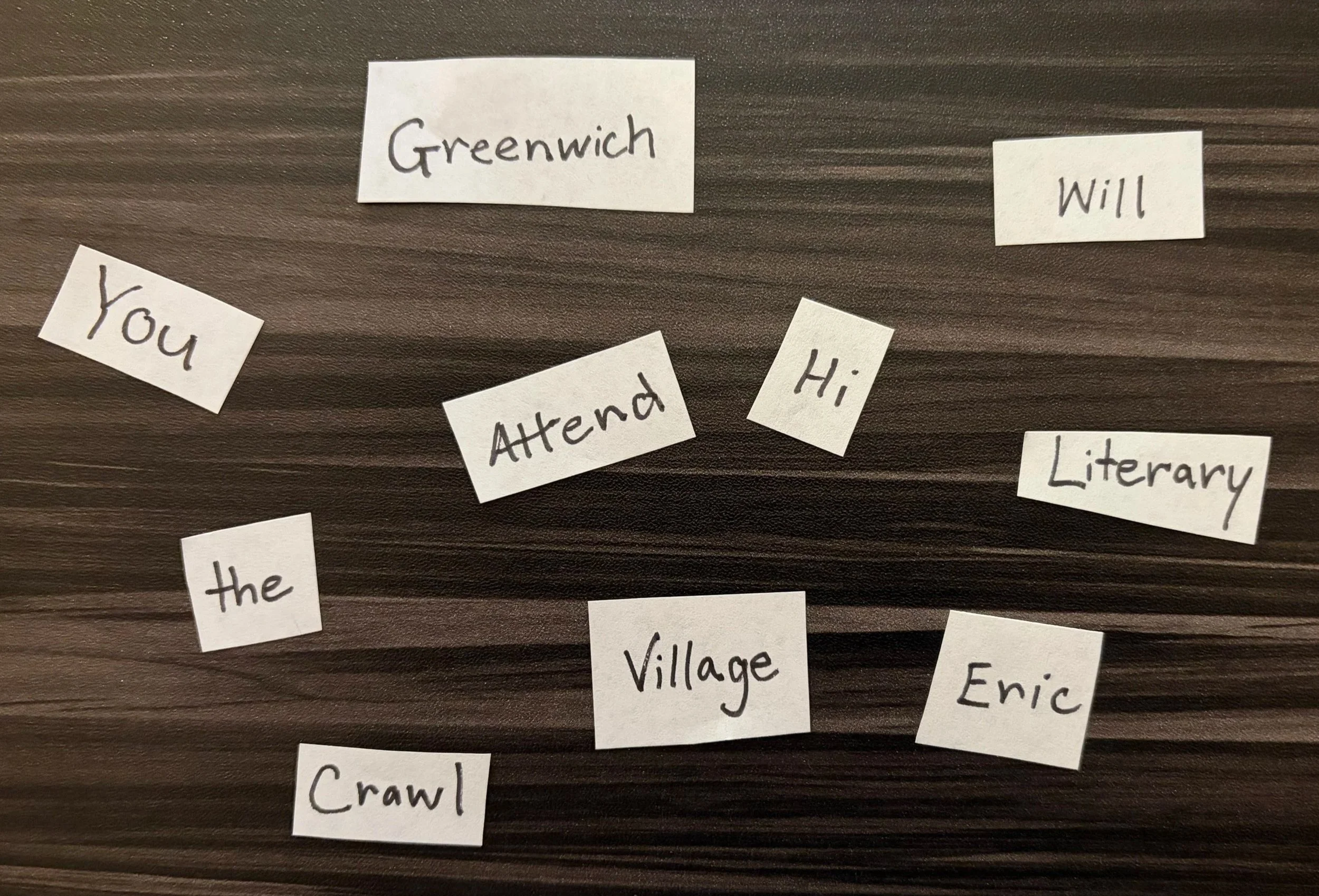
Burroughs was drawn to the occult his entire life, and determined these acts were caused by possession of a malevolent energy he called the “Ugly Spirit”. He believed that through writing, he could gain control of this inherent badness. This interest was furthered when he met painter Brion Gysin, who studied Moroccan magic. Together, they would popularize the cut-up, an aleatory literary technique that relies on writing words on slips of paper and choosing them randomly. Gysin was already using this technique before meeting Burroughs, most likely inspired by French-Romanian poet Tristan Tzara who outlined this method in “Dada Manifesto on Feeble & Bitter Love”. He co-founded the anti-establishment, anti-art, anti-rational, movement called Dadaism, after being disgusted with the displays of nationalism that led to WWI. Collage and assemblage is one of the foundational attributes of Dadaist work, creating juxtapositions that challenge reality. With the use of cut-up, Tzara felt it stripped the work from established conventions, while still maintaining the author’s identity, declaring, “Poetry is for everyone”.
After reviewing Gysin’s work, Burroughs thought this technique was similar to his use of juxtapositions in Naked Lunch, leading him to begin experimenting with the text. You can read about these experiments in his Paris in Minutes To Go, San Francisco in The Exterminator, and The Third Mind, also written with Gysin. Their hope was that these texts would introduce this technique to the general public. Novels Burroughs created using this method include The Soft Machine, Nova Express, and The Ticket that Exploded. They would go on to inspire other artists, especially musicians, to try this technique. John Lennon was a huge fan of both Burroughs and the cut-up, using it when writing lyrics for “A Day in the Life” and “Lucy in the Sky with Diamonds”. Other musicians inspired by this technique include David Bowie, Bob Dylan, Kurt Cobain, and Thom Yorke. Bowie referred to it as “a very Western tarot”, explaining, “What I’ve used it for, more than anything else, is igniting anything that might be in my imagination… It can often come up with very interesting attitudes to look into. I tried doing it with diaries and things, and I was finding out amazing things about me and what I’d done and where I was going”.
Just as Tzara was using cut-up as a means of freeing poetry from restrictive literary convention, Burroughs was interesting in using it as a means to unlock conventional patterns of thought and perception, similar to his beloved drugs. For Burroughs, cut-up was a tool to alter consciousness. He began using the technique as a form of divination, stating, “When you cut into the present the future leaks out”. Interested in the occult and magic from a young age, as a child he saw an apparition of a green reindeer in the woods, his totem animal. In addition to other sightings such as ghosts, he grew up with an understanding that the veil between the known and unknown was not only thin, but permeable. This would fuel his idea that all of the bad choices and actions of his own doing were due to possession, which much later in his life would be reportedly exorcised by a Native American shaman. Really makes modern day “ghosting” seem preferable.
During the time of the cut-up experiments at the infamous Beat Hotel in Paris, he was also practicing other forms of the occult include scrying (mirror gazing), trance, and telepathy, induced by a variety of drugs, to provoke visions. He dabbled with several spiritual groups in his life, becoming a member of the chaos magic organization The Illuminates of Thanateros. He believed that this world was a magical universe with no coincidences, only the results of human will. His later work, The Western Lands, was heavily inspired by occult allegory, especially the Egyptian Book of the Dead. One of the many things that makes Burroughs interesting is how open and honest he was about studying and practicing the occult, influencing his literary works. He was a true believer, and as Norman Mailer said in 1962, “the only American novelist living today who may conceivably be possessed by genius”.
So this weekend when you’re feeling bored and uninspired, write down some phrases, cut them up, throw them in a bowl, and see what leaks out of your mind onto the page. If it’s good enough to get published, we’d like credit (or at least a dedication).